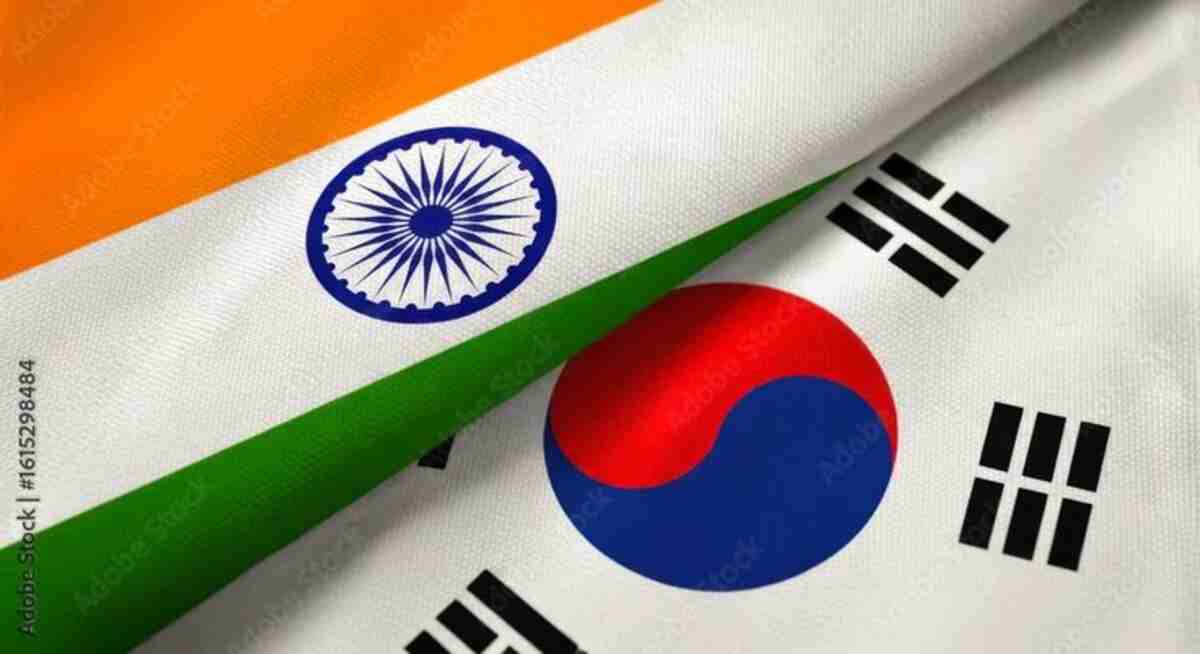
India and South Korea have taken a decisive step to deepen their economic partnership, announcing ambitious plans to nearly double bilateral trade from around 27 billion dollars to 50 billion dollars by 2030. The agreement was reached during South Korean President Lee Jae Myung’s three-day state visit to New Delhi, his first official trip to India since assuming office. Prime Minister Narendra Modi hosted the South Korean leader on April 20, 2026, in what both sides described as a significant boost to their Special Strategic Partnership.
Current trade between the two nations stands at approximately 26 to 27 billion dollars annually, with South Korea maintaining a substantial surplus. Indian exports to South Korea include items such as petroleum products, chemicals, and textiles, while Seoul supplies high-value goods like semiconductors, automobiles, shipbuilding components, and steel. During the summit, leaders pledged to address the trade imbalance through greater market access, upgraded cooperation, and targeted investments in emerging sectors.
A key outcome of the meetings is the decision to accelerate negotiations for upgrading the Comprehensive Economic Partnership Agreement (CEPA), originally signed in 2010. Both governments have instructed their teams to resolve outstanding industry-specific issues and conclude the revised pact as quickly as possible. The upgraded CEPA is expected to reduce tariffs further, simplify regulations, and open new opportunities for small and medium enterprises from both countries.
Cooperation will expand significantly in strategic areas including shipbuilding, semiconductors, critical minerals, green energy, and steel. South Korean companies already operate more than 650 firms in India, with major players like Samsung, Hyundai, and LG contributing to manufacturing and technology sectors. The new framework aims to attract additional Korean investment while encouraging Indian firms to explore opportunities in South Korea’s advanced industrial ecosystem.
Energy and supply chain resilience formed another important pillar of the discussions. Both nations agreed to collaborate on critical minerals, renewable energy projects, and diversified supply chains to reduce dependence on single sources amid global uncertainties. Modi highlighted the complementary strengths of the two economies, noting India’s vast market and young workforce alongside South Korea’s technological expertise and innovation capabilities.
The summit also touched upon defense and security ties, with both sides expressing commitment to joint naval exercises and broader strategic coordination. However, the primary focus remained on economic deliverables that deliver tangible benefits to businesses and citizens. President Lee emphasized that strengthening ties with India forms part of South Korea’s broader strategy to diversify partnerships in the Indo-Pacific region.
For India, the deal aligns with its goal of expanding exports and attracting foreign direct investment in high-tech manufacturing. Government officials pointed out that enhanced access to the South Korean market could benefit Indian pharmaceutical, automotive component, and IT services sectors. Meanwhile, Korean businesses stand to gain from India’s rapidly growing consumer base and policy reforms aimed at easing doing business.
Analysts view the renewed push as timely, given shifting global trade dynamics and efforts by many countries to build resilient supply chains. The target of 50 billion dollars in bilateral trade by 2030 represents a compound annual growth rate that will require sustained effort from both public and private sectors. Business forums held alongside the summit saw enthusiastic participation, with memoranda of understanding signed in areas such as technology transfer, joint ventures, and skill development.
The visit also carried cultural and people-to-people dimensions, reinforcing the warm relations between the two democracies. Modi described the partnership as one built on shared values and mutual prosperity, while Lee expressed optimism that the new agreements would create jobs and drive innovation on both sides.
Implementation will now move to working-level committees tasked with monitoring progress toward the 2030 target. Regular reviews and business-to-business engagements are expected to keep momentum alive. Industry bodies from both countries welcomed the announcement, calling it a positive signal for investors seeking stable and high-growth markets.
This latest development builds on years of steady but modest growth in India-South Korea ties. With clear political will demonstrated at the highest level, the two nations appear determined to transform their economic relationship into a more balanced and dynamic force. As negotiations on the upgraded CEPA advance and new projects take shape, businesses and policymakers will watch closely to see how quickly the 50 billion dollar vision translates into reality.
The pact not only promises stronger commercial links but also contributes to broader regional stability through deeper economic interdependence. For global markets, it signals continued openness and cooperation b
India and South Korea Seal Landmark Pact to Nearly Double Bilateral Trade to 50 Billion by 2030